
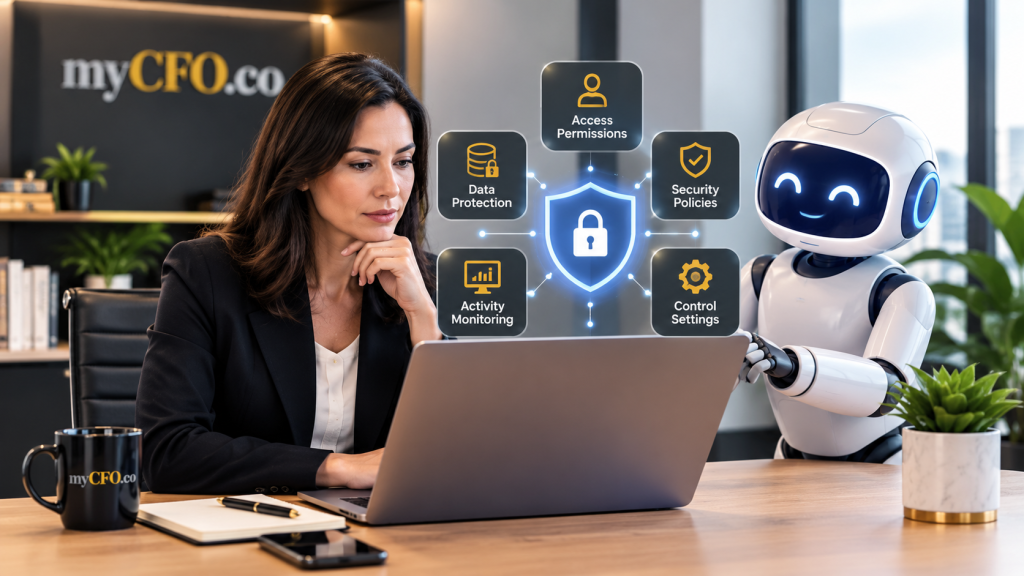
AI agents are moving beyond answering questions and generating content. They can now connect with accounting platforms, CRMs, email systems, project management tools and other business applications to retrieve information, analyse data and take actions.
For Australian SMEs, this creates a genuine opportunity. An AI agent could help reconcile information, prepare reports, identify unusual transactions, update records, assist with customer enquiries or support financial forecasting.
But there is an important difference between giving an AI tool information and giving an AI agent access to your business systems.
Once an AI agent can take action, the risk changes. A mistake is no longer limited to an incorrect answer in a chat window. An agent could potentially send an email, alter a record, access confidential information or trigger a transaction.
That does not mean Australian businesses should avoid AI. It means AI adoption needs practical controls.
For businesses working with myCFO.co, the same principle applies to financial technology and automation. Technology can improve the speed and availability of financial information, but the controls should mature with the capability. The objective is not automation for its own sake; it is better information, stronger decisions and clear accountability.
Here are five controls every Australian SME should consider before giving an AI agent access to important business systems.
1. Control Exactly What the AI Agent Can Access
The first question should not be “What can this AI agent do?”
It should be “What does this AI agent actually need access to?”
If an agent is being introduced to help with reporting, it may need access to selected financial information. It probably does not need unrestricted access to payroll, customer records, banking credentials and every document stored within the business.
This is where access controls for AI become important.
Use the principle of least privilege. Give the agent only the systems, information and permissions required for its specific task.
For example, an AI agent helping prepare a weekly management report might be allowed to read selected accounting data and KPI information. It may be allowed to generate a draft report but not change financial records or approve payments.
This distinction can significantly reduce the potential impact of an error.
Before connecting an AI agent, document:
- Which systems it can access
- What information it can read
- What information it can modify
- Which actions it can perform
- Which actions require human approval
- When access should be removed
For growing Australian businesses, this should form part of a broader financial controls and technology governance process.
2. Protect Sensitive Business and Customer Data
AI systems can work with large amounts of information, which makes data governance particularly important.
An SME might have customer details, employee information, pricing information, supplier contracts, financial statements and commercially sensitive information spread across different systems.
Before providing this information to an AI agent, understand exactly how the provider handles the data.
Ask:
- Where is the data stored?
- Who can access it?
- Is information used to train models?
- How long is information retained?
- What happens if the provider experiences a security incident?
- Can access and permissions be controlled?
- What happens to the information if you terminate the service?
For Australian businesses, privacy and data protection should be considered before connecting AI tools to systems containing personal or commercially sensitive information.
Strong AI data governance and security do not necessarily require an entirely new framework. Existing privacy, cybersecurity and information-management processes should be reviewed to ensure they also cover AI use.
This is particularly important when AI interacts with accounting, CRM, HR or customer systems.
3. Put Human Approval Around High-Risk Actions
An AI agent should not automatically make every decision simply because it technically can.
The higher the financial or operational consequence, the stronger the case for human approval.
Consider the difference between these actions:
An AI agent creates a draft monthly management report.
An AI agent changes a supplier’s bank account details.
An AI agent sends a customer a routine appointment reminder.
An AI agent approves a large supplier payment.
These should not all operate under the same level of automation.
For an Australian SME, sensible AI human oversight could mean requiring a person to approve:
- Payments
- Changes to bank details
- Contracts
- Refunds above a defined threshold
- Customer communications involving disputes
- Changes to financial records
- Significant pricing changes
- Employment related decisions
This approach is particularly important for businesses using technology to support financial operations.
AI can process information quickly, but business decisions still require context, judgement and an understanding of commercial consequences.
This is where experienced CFO judgement remains important. AI can help identify information and patterns, while management and experienced finance professionals assess the commercial implications, challenge assumptions and determine whether action is appropriate.
4. Keep an Audit Trail
If an AI agent takes action inside your business, you should be able to answer a simple question:
What did it do, why did it do it and who approved it?
Without an audit trail, investigating an error becomes difficult.
For SMEs, practical AI governance should include records of important AI activity. Depending on the system, this may include prompts, actions taken, data accessed, approvals provided, exceptions identified and changes made.
For example, if an AI agent prepares a cash flow forecast, your team should be able to identify the source data used and understand how the final numbers were produced.
This is especially important for cash flow forecasting, KPI reporting and management reporting. Financial information should remain traceable back to reliable source data.
An audit trail also helps business owners understand whether an AI system is actually delivering value.
If an automated process repeatedly requires manual correction, that may indicate the workflow needs to be redesigned rather than simply giving the AI more access.
For SMEs, the process does not need to become bureaucratic. A simple AI register and clear activity logs can provide much better visibility than allowing multiple employees to connect unapproved AI tools to business systems.
5. Test the Agent Before Letting It Operate Independently
Never assume an AI agent will behave correctly simply because it performed well during a demonstration.
Test it against real business scenarios before giving it unrestricted access.
For example, if the agent is being used for commercial finance analysis, test what happens when:
- Data is incomplete
- Two systems contain different figures
- A transaction looks unusual
- A supplier record has changed
- A forecast contains unexpected movements
- The agent receives an ambiguous instruction
- Information is outside the agent’s defined scope
You should also test what happens when the AI gets something wrong.
Can the action be reversed?
Can the agent be paused?
Can a person override it?
Can access be removed quickly?
Can the business continue operating if the AI system becomes unavailable?
The instructions given to an AI agent can also affect the quality and consistency of its output. Clear instructions, relevant context and defined objectives can help reduce ambiguity when an AI system is being used as part of a business workflow.
AI Prompt Engineering Clear instructions and prompt design are useful, but they are only one part of a controlled AI workflow. They should sit alongside access limits, reliable source data, testing, approval points and monitoring.
Businesses should also test the commercial case for automation: current process cost, implementation cost, hours saved, error reduction, cash-flow impact and expected payback period. This is the focus of the myCFO.co AI Productivity & ROI Review.
How AI Can Support Better Financial Decisions
The biggest opportunity for SMEs is not simply using AI to automate more tasks.
It is using technology to improve the quality and speed of information available to decision makers.
For example, an AI system may help collect financial information, identify trends or prepare an initial analysis. A CFO can then review that information, challenge assumptions and connect it with the wider commercial position of the business.
This combination can support better financial decision support, more reliable financial forecasting, clearer KPI reporting and stronger cash flow visibility.
That is particularly valuable for Australian SMEs that may not need a full-time CFO but still need experienced financial leadership as the business grows.
The role of technology should be to make financial information more useful. The role of experienced CFO support is to determine what that information means and what the business should do next.
fractional CFO Australia This approach fits naturally within a fractional CFO model. Instead of treating AI as a replacement for financial expertise, businesses can use it to make financial processes faster and more useful while retaining appropriate human review and accountability.
A Practical AI Control Checklist for Australian SMEs
Before giving an AI agent access to your systems, ask:
Access: Does the agent have only the permissions it actually needs?
Data: Are confidential and personal information properly protected?
Approval: Which actions require a person to review and approve them?
Audit: Can we see what the agent did and trace important actions back to its source?
Testing: Have we tested normal situations, exceptions and failure scenarios?
If the answer to any of these questions is unclear, the AI agent may not be ready for unrestricted access.
AI can become a valuable part of an SME’s operating model, but automation should not remove accountability. The strongest approach is controlled automation, reliable financial information, experienced human oversight and clear accountability.
For business owners, that means AI can handle more of the repetitive work while leadership retains control over the decisions that affect cash flow, profitability, risk and growth.
Frequently Asked Questions
Is AI safe for Australian SMEs?
AI can be used more safely and responsibly when businesses apply appropriate controls around access, data, cybersecurity, testing, monitoring and human oversight. The level of control should reflect the potential risk of the particular AI use case.
What is an AI agent?
An AI agent is software that can use AI models to perform actions toward a defined goal. Unlike a basic chatbot, an agent may interact with other business systems and take actions with less direct human input.
Should an AI agent have access to accounting software?
Only when there is a clear business purpose and appropriate permissions. Access should be limited to the information and functions the agent genuinely needs, with stronger approval controls for high risk financial actions.
Can AI be used for financial forecasting?
Yes. AI can assist with analysing financial information, identifying patterns and supporting forecasting processes. However, financial forecasting should still be reviewed against business assumptions, operational conditions and management judgement before important decisions are made.
What should an SME check before choosing an AI provider?
Businesses should review the provider’s security measures, privacy practices, data retention arrangements, access controls, system capabilities, contractual terms and approach to AI governance.
Can a CFO help assess AI investment and governance?
CFO support Yes. A CFO can help assess where AI may create commercial value, test the business case, identify financial and governance risks, and establish appropriate approval and reporting controls. Technical implementation and cybersecurity should remain with appropriately qualified technology specialists.
What if my business is not ready for a fully autonomous AI agent?
You do not need to start with full automation. A practical approach is to begin with lower risk tasks such as data analysis, report preparation, KPI monitoring or draft communications. As the business understands the technology and its risks, additional capabilities can be introduced with appropriate controls.
Conclusion
AI agents can give Australian SMEs access to faster analysis, automation and better operational visibility. But giving an AI system access to your business is not simply an IT decision.
It is a business control decision.
Start with limited access, protect sensitive data, require human approval for high-risk actions, maintain an audit trail and test the system before allowing it to operate independently.
Used this way, AI can complement experienced financial leadership rather than replace it, helping SMEs improve cash flow forecasting, KPI reporting, commercial finance analysis and everyday financial decision support.
For Australian businesses considering where AI can create measurable value in finance or operational workflows, the myCFO.co AI Productivity & ROI Review can assess current process cost, implementation cost, hours saved, error reduction, cash-flow impact, governance risk and expected payback period. The objective is simple: AI-assisted analysis, experienced CFO judgement and commercial accountability.